Cricket Explained for Baseball Fans
Cricket Explained for Baseball Fans
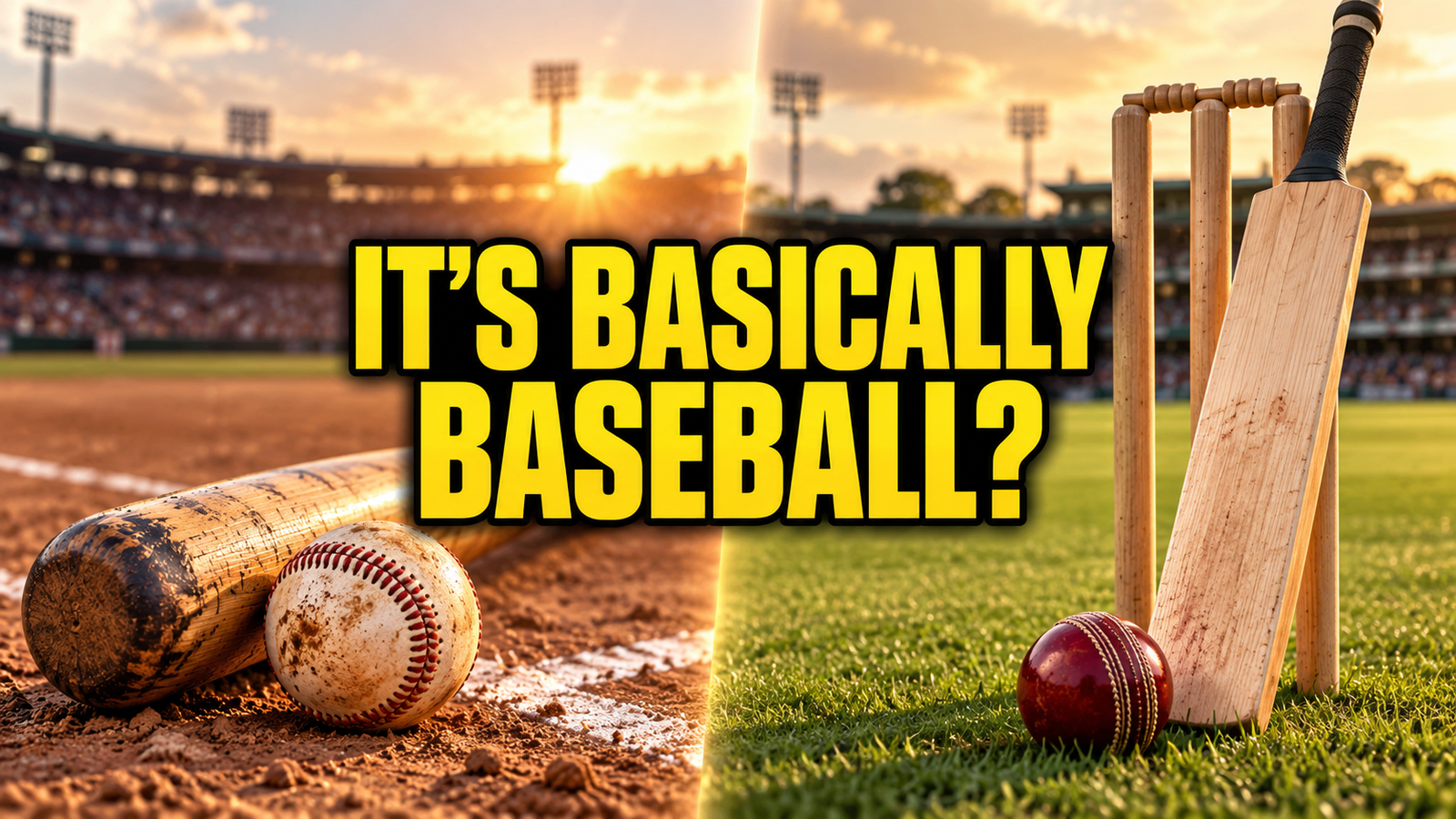
If you understand baseball, you already understand about 70% of cricket. Somebody throws a ball, somebody swings a bat, fielders try to catch it, and runs go on the board. The rest is mostly vocabulary and a few rules that sound insane until they don’t.
You’ll want to figure it out soon. Cricket returns to the Olympics at LA28 for the first time since 1900, and it’s being played in Southern California. Billions of people follow this sport. Americans are about to find out why.
Baseball to cricket, translated
| Baseball | Cricket | The difference |
|---|---|---|
| Pitcher | Bowler | Bowls with a straight arm, and the ball usually bounces before it reaches the batter |
| Batter | Batter (or batsman) | Two batters are on the field at once, one at each end |
| Home plate | The wicket (three stumps with two small bails on top) | The batter defends it. Hit it with the ball and they’re out |
| Strike zone | No zone at all | There are no balls and strikes. A batter can stay in all day |
| Inning | Innings | In a T20 game each team bats once, for 20 overs |
| Out | Wicket | Ten wickets and the whole team is “all out” |
| Running the bases | Running between the wickets | Batters swap ends of a 22-yard strip. Each swap is one run |
| Home run | Six | Ball clears the boundary without bouncing. Worth 6 runs, automatically |
| Ground-rule double | Four | Ball reaches the boundary after bouncing. Worth 4 runs |
| Foul ball | Doesn’t exist | The field is a full 360 degrees. Hitting it behind you is a legit shot |
| Catcher | Wicketkeeper | Wears gloves and pads, stands behind the stumps |
| Nine innings | Two innings (one per team) in T20 | A T20 game runs about three to three and a half hours |
That last row surprises people. A T20 match is shorter than a lot of MLB games used to be before the pitch clock.
How a T20 game works
T20 is short for Twenty20, and it’s the version you’ll see at the Olympics. It’s the fast, loud, made-for-TV format. Think of it as cricket’s answer to the pitch clock.
The captains flip a coin. The winner picks whether to bat or bowl first.
The batting team sends out two batters. The fielding team puts all 11 players on the field, and one of them bowls. Bowling happens in overs, which are sets of six legal deliveries. After each over, a different bowler takes over from the other end, and nobody can bowl more than four overs in a T20 game. So a team needs at least five bowlers. No ace throwing a complete game here.
The batting team gets 20 overs (120 balls) to score as many runs as it can. Their innings ends when the overs run out or when they lose 10 wickets, whichever comes first. Why 10 and not 11? Because you always need two batters out there, so once the tenth one’s out, the last guy has nobody to run with.
Then the teams swap. The second team knows exactly what it needs, say 171 runs off 120 balls, and the whole chase becomes a math problem with a crowd screaming at it. That’s where the drama lives. If they pass the target, they win. If they don’t, the team that batted first wins.
There’s no extra innings either. A tie goes to a Super Over, where each team gets one over to outscore the other. It’s basically a penalty shootout with bats.
Scoring runs and getting out
Here’s the part that breaks a baseball brain: the batter doesn’t have to run. Ever. They can block the ball, leave it alone, or hit it and stay put. Running is a choice, so batters only go when they think they’ll make it.
Runs come three ways. Batters run between the wickets for 1, 2 or 3 runs. They hit boundaries for 4 or 6. And the bowler can gift runs through extras, like a wide (too far from the batter to hit) or a no-ball (usually overstepping the crease line). Both add a run and force the bowler to bowl that ball again. In T20, a no-ball also gives the batter a free hit on the next delivery, meaning they can’t be bowled, caught or LBW on it. Swing away.
There are around ten official ways to get out, but you’ll see five of them 99% of the time.
Bowled. The ball hits the stumps and knocks a bail off. The cleanest out in the game, and the bowler’s favorite.
Caught. A fielder catches the ball before it bounces. Same as a flyout.
LBW (leg before wicket). The ball hits the batter’s leg when it would’ve gone on to hit the stumps. This one causes more arguments than any other rule, and it’s why teams can challenge decisions with ball-tracking replays.
Run out. A fielder hits the stumps with the ball before a running batter reaches the crease. Basically getting thrown out at the plate.
Stumped. The batter steps out of the crease to swing, misses, and the wicketkeeper knocks the bails off. Think of it as a pickoff with extra embarrassment.
One more thing. A batter who gets out without scoring is out for a duck. A batter who scores 50 has hit a half-century, and 100 is a century. Centuries in T20 are rare enough that the crowd stands up for them.
Yes, some games really last five days
T20 is only one of three main formats, and it’s the youngest.
One Day Internationals (ODIs) give each team 50 overs. A game takes most of a day, roughly seven or eight hours with a break between innings.
Test cricket is the original, and it’s the one that made Americans think cricket fans had lost their minds. Each team bats twice, there’s no over limit, and a match can run up to five days. Players wear white. They stop for lunch. They stop for tea, which is an actual scheduled break and not a joke.
The strangest part? A Test can end in a draw. If time runs out before one team finishes off the other, nobody wins, even after five days. To a baseball fan that sounds like a scam. To a cricket fan it’s the whole point, because a team that’s losing badly can still “save” the match by surviving long enough. Some of the most famous innings in history were one batter blocking ball after ball for an entire day to hang on for a draw. It’s less exciting than a walk-off, sure. It’s also weirdly gripping once you know what’s at stake.
Tests are cricket’s version of a pitchers’ duel. T20 is the home run derby. The Olympics went with the derby.
Cricket in America (it’s been here longer than baseball)
Cricket has been played in the US for more than 300 years. The first international match in any sport happened in 1844 in New York, the US against Canada, in cricket. Baseball eventually ate its lunch, but the game never fully left.
It’s coming back fast now. Major League Cricket launched in 2023, and Grand Prairie Stadium in Texas was built for it, one of only two permanent US venues that regularly host international matches. The other is in Lauderhill, Florida.
Then there’s LA28. Cricket’s only previous Olympic appearance was in Paris in 1900, so this ends a 128-year wait. All matches will be played at a temporary, purpose-built stadium at the Fairgrounds in Pomona, about 50 km (31 miles) east of downtown Los Angeles. Six men’s teams and six women’s teams will compete, each with 15-player squads, in the T20 format.
The tournament runs July 12 to 29, 2028. The women’s medal matches are on July 20 and the men’s on July 29. Most days are doubleheaders, with games at 9:00 a.m. and 6:30 p.m. local time. That morning slot is no accident: it lines up with prime time in India, where a huge share of the world’s cricket fans live.
The ICC decides who qualifies, and the US will be pushing hard for a host spot. Fair warning, though. Once you watch a tight T20 chase come down to the last over, you might not go back.
Cricket words you’ll hear on the broadcast
| Term | What it means |
|---|---|
| Pitch | The 22-yard strip between the two wickets (not the throw) |
| Crease | The white line a batter must stay behind to be safe |
| Over | Six legal deliveries by one bowler |
| Wicket | The stumps, or a dismissal. Context tells you which |
| Innings | One team’s turn to bat (always ends in “s,” even when singular) |
| Run rate | Average runs per over |
| Required rate | Runs per over the chasing team needs to win |
| Yorker | A ball aimed right at the batter’s feet. Nasty to hit |
| Bouncer | A short ball that rears up toward the batter’s head |
| Spinner | A slow bowler who makes the ball turn off the pitch |
| Duck | Out for zero |
| Maiden | An over where the bowler gives up no runs |
| Powerplay | The first six overs in T20, when only two fielders can stand outside the inner circle |
| Death overs | The last few overs of an innings, when everyone swings hard |
FAQ
Is cricket harder to understand than baseball?
Not really. It just uses different words. Once you know that an over is six balls and a wicket is an out, most of a T20 game makes sense within 20 minutes.
How long does a cricket match last?
It depends on the format. A T20 game takes about three to three and a half hours, a One Day International takes most of a day, and a Test match can run up to five days.
Why does the ball bounce before it reaches the batter?
Because bowlers use the pitch as a weapon. The bounce lets them make the ball swerve, spin or jump unpredictably, which is a big part of the skill.
Can a batter really hit the ball in any direction?
Yes. There’s no foul territory, so batters regularly hit the ball behind them on purpose. Some of the most popular shots in T20 go straight over the wicketkeeper’s head.
Will cricket be in the 2028 Olympics?
Yes. Men’s and women’s T20 tournaments, with six teams each, will be played at the Fairgrounds in Pomona, California, from July 12 to 29, 2028.
Has cricket been in the Olympics before?
Once, at the 1900 Paris Games. LA28 ends a 128-year gap.
Where can I watch cricket in the US?
Major League Cricket plays its season in the summer, including games at Grand Prairie Stadium in the Dallas-Fort Worth area. International T20 leagues also stream year-round.